
















On a Wednesday afternoon in the Reggie Gymnasium, surrounded by friends and family, each recruited senior athlete scrawled their signature across a piece of paper signifying their commitment to play athletics in college. For many, the moment was the light at the end of the tunnel after a difficult, often turbulent journey.
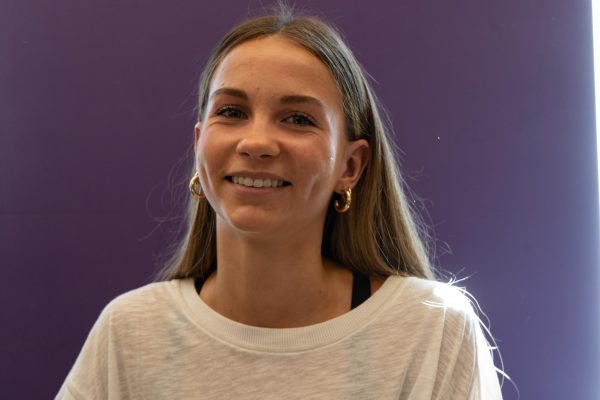
For many North’s student-athletes like senior Zoe Antebi, who recently committed to Grinnell College for soccer, the recruiting journey is a stressful process that begins as early as middle school. The recruitment process demands acute organization and determination, as well as exceptional athletics from a young age.
Antebi emphasized the importance of perseverance throughout her recruitment process. “The process can be a bit ambiguous sometimes so you have to be really persistent and keep an open mind,” she said.
Athletic Director Mike Jackson said, “The college recruiting process is a spectrum. It can be really cool but extremely stressful at the same time.”
According to Jennifer Moeller, a college and career counselor, student-athletes must undergo the same application process as other students, but they face the added pressure of recruitment.
“The big thing that sometimes gets lost in the recruitment process is that the student still needs to apply to college,” said Moeller.
Moeller also added that the sway that college coaches have over admissions officers is often overestimated, but it still can have an impact.
“If the coach really has pull with the admissions office and really wants a student-athlete on their team, it can play a big role, but sometimes it can be tough for students to gauge if that spot is still theirs,” said Moeller.
Junior Sasha Selivan, who recently committed to play Division I volleyball at Colgate University, learned the critical value of open-mindedness throughout her recruiting process. She said that her experience was extremely difficult and unpredictable, and she had to tackle the challenge with positivity.
“Sometimes I thought a school really wanted me, but then the next day I’d see they already committed someone else. It was tough,” said Selivan.
Long before most students started considering colleges at all, Selivan was reaching out to coaches and attending ID clinics, showcases for student-athletes to display their skills to college coaches.
Antebi also began contacting schools early, and faced similar struggles to Selivan. “I started emailing coaches and going to ID clinics in middle school,” she said. “Even with early preparation, the process still didn’t go as planned.”
Despite her exceptional soccer skills, Antebi’s journey to signing day was difficult and full of bumps in the road, like her poorly timed ACL injury that took her out of commission for the entirety of her junior year.
Because Antebi tore her ACL right before June 15, the date that Division I coaches can begin reaching out to players, the injury complicated her journey further. Antebi was stuck on the bench while her teammates continued receiving offers. “Coaches weren’t able to see me play,” said Antebi. “I would go to showcases and just be on the bench and that was difficult because I felt like I couldn’t really make any progress during that time.”
Antebi added, “By the time I was back on the field, schools had already filled all the spots for my class.”
Once Antebi was cleared to play, she had to find unique ways to stay engaged with coaches and showcase her abilities.
“I did training over the summer and I would film as much of it as I could,” said Antebi. “Putting out as much film as possible really helped not only just show my ability, but also my dedication and my work rate.”
Although Selivan and Antebi began their planning early on, student-athletes can find college athletics opportunities without prior preparation. Senior Zahgros Tanner, who is committed to play Division III baseball at Brandeis University had a much more relaxed experience with his process, only beginning to reach out to coaches in the fall of his junior year.
“I let how I perform talk for itself. The only thing I really worried about was just being better and training harder, but nothing with the recruiting process was really stressful,” said Tanner.
Tanner added that he believes there’s no reason to stress about recruitment during students’ sophomore or junior year.
“Just play,” said Tanner. “If you perform, it’ll work out.”
Though Tanner had a relaxed perspective, he also acknowledged the uncertainties of the process. “You can get injured. Something bad can happen. So it’s always important to keep your options open,” he said.
Tanner added that he chose Brandeis because of the athletic-academic balance that it offered.
Antebi echoed that sentiment, saying, “I really wanted a more rigorous academic school and as well I’d like a really competitive and supportive soccer environment. I felt that Grinnell was the best school that had the balance of all those things for me.”
North’s annual senior signing day featured commitments from one Division I student-athletes, one Division II student-athlete, and five student-athletes set to attend Division III schools.
Jackson said, “My biggest piece of advice is doing your research. Find the schools that you like for academics as well, and be very deliberate about your choices.”
Despite their different paths, all three athletes said that social media’s portrayal of the process appears simpler than its reality. It requires dedication, hard work, and patience, and even then there are no guarantees, but things often work out in the end.
According to Selivan, even though the process was different than she expected, she was grateful for the experience because she learned a lot along the way.
Antebi said, “The school you thought you were meant to be at might not work out, and that’s okay because you’ll definitely find a school for you.”