



















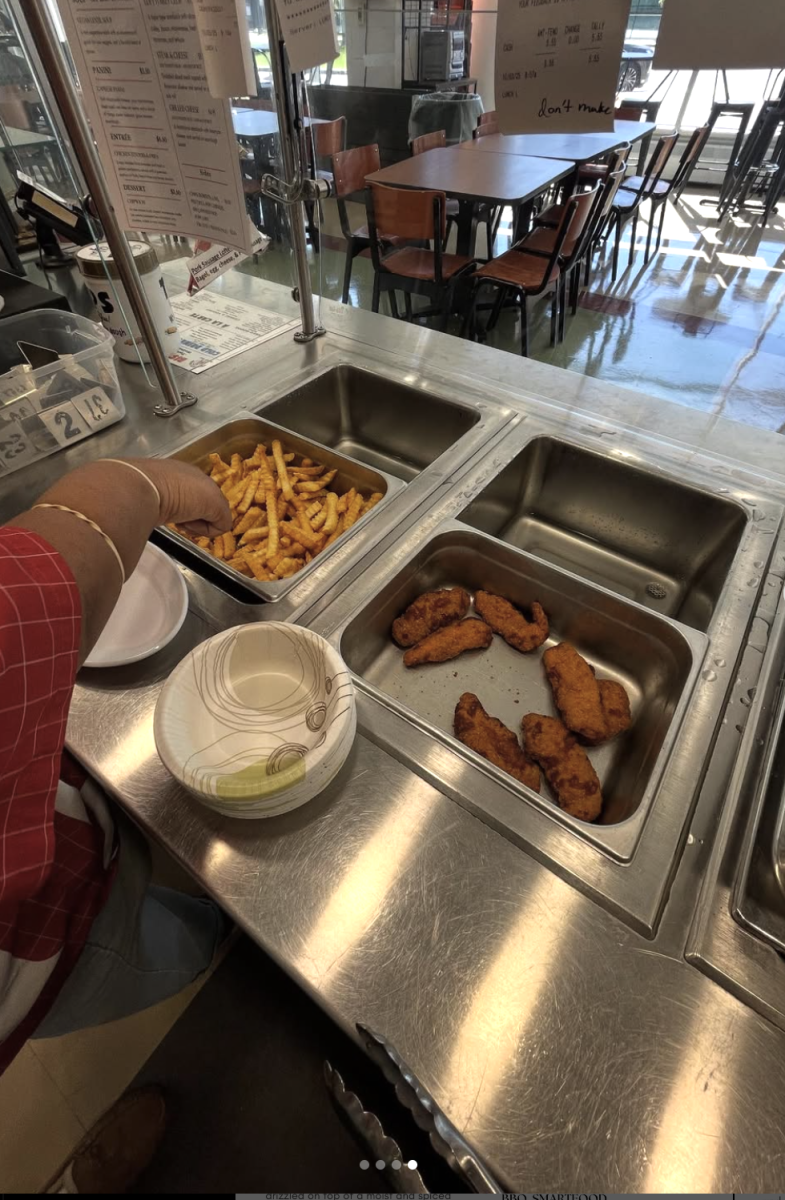
The Tiger’s Loft Bistro is an on-campus and entirely student-run restaurant, open during second and third lunch. While lines of students stretch into the hallways during second and third lunch, culinary students of all levels—Exploratory, Major I, Major II, and Major III—are busy behind the counter cooking hot entrées, preparing drinks, and managing customers.
The Loft is split into three different sections, each with their own specific duties and managed by a different culinary teacher. “Bakery” is managed by Christopher DeRocher, “Savory” by Alexis Lugbauer, and “Front of House” by Lisa Marzilli.
Bakery is in charge of desserts and pastries. “Desserts often need a lot more prep time than other things we serve, so we usually make them ahead of time,” said senior Andy Zou, a Major III. Savory, on the other hand, produces entrées and other hot items, which are typically made or assembled on order.
Front of House is different from the other two sections because the section directly deals with customers during the morning and lunch rushes. According to senior Duncan Yens, a Major III, jobs include working the cash register, line assemblers, expeditors, and runners.
“Line actually creates or assembles the dishes, and then there’s expeditors, which gather the food and bring it to the front,” said Yens. “And then there’s runners, who give the food to the customer that bought it—that’s why we give out the little number tents.”
According to DeRocher, by operating the class as a business open to the student body, culinary students are prepared for employment in both food service industries and customer service-based industries. “That’s something that’s very hard to teach in a classroom setting,” he said.
In addition to working lunch rushes, students are able to sign up for an “Early Bird” shift—from 7:15 a.m. to 8:50 a.m.—to operate the Loft during the morning. According to Zou, students are paid $12 per hour for Early Bird since it is outside of school hours, but are not paid for working during lunch. Because the Loft is not a for-profit business, prices are kept as low as possible for customers, and working at the Loft without pay during lunch helps to lower prices. “We do it to keep afloat,” said Zou.
All Loft staff begin from Exploratory Culinary Arts, a semester class where students learn basic kitchen skills, including knife handling and measuring, according Yens.
As students proceed to Major I, they are given the ability to operate independently in the Loft with simple food preparation tasks, and as Major IIs, they gain further autonomy and are even able to design their own dishes to go on the Loft’s menu through a class project.
“Their menu project is when they figure out all their recipes, their ordering process, when they will be going, and they pretty much make an entire menu for that week,” said Yens. “And then with that, they also go through and they teach everyone how they want their dish to look.”
According to Zou, after completing Major II, students advance to Major III, where students are given more freedom with dish designs and leadership becomes a key focus. Leadership roles include directing younger staff members or ordering the necessary supplies to keep the restaurant running. “The teachers are much more reliant on us,” Zou said.
Zou added that all culinary students are mandated to participate in safety procedure training before being allowed to work in the Loft, including allergy awareness and food temperature control. “Once everything is done, you get to work in the Loft, where you get trained to do our specialties like the paninis, the steak and cheeses—you get taught how to make everything,” added Zou.
Being an official food service provider registered in Newton, the Loft is required to abide by city health regulations. According to DeRocher, in addition to training all staff, the Loft undergoes two inspections from the Newton Health Department.
“The health inspector checks all kinds of aspects of our operation, between the temperatures of the refrigerators, student food handling, and making sure all of our equipment is operating properly,” said DeRocher.
DeRocher added that students present during the health inspection are subject to questions about proper food handling techniques, hand washing, food storage, or food temperatures. According to Yens, for this reason, students must thoroughly internalize these sets of rules.
“Everyone knows what they’re doing before they even walk into the kitchen—and we practice,” said Yens. “Chef D recently has been going around and asking people like a pop quiz of these questions to make sure that it’s really drilled into your brain.”
As a Career and Technical Education class, Culinary can take up multiple dedicated blocks during the day, which can feel taxing for students and limit the courses that they are able to take.
“I have sacrificed a lot for this program,” said Yens. “I love playing the trombone and I was in Jazz Band for a while, but I had to drop it to pursue Culinary.”
Additionally, Major IIIs have b, c, and d-blocks dedicated to Culinary. “There’s times where you can feel burnt out from the amount of work you get, especially as a Major III when you’re working through three blocks—and especially if I’m here since 7 in the morning,” added Zou.
Despite the extensive work that Culinary and working at the Loft requires, it ultimately serves as a learning experience beyond what most schools are able to offer.
“Getting to see firsthand making food in the back of the house and then serving it in front is very gratifying,” said Yens. “You can see happy faces, and it feels nice. I like having a home here.”